

Crew Verification with Compliance Links: Why Role-Specific Matters
Verify crew against each role's exact requirements, not generic compliance. See how Compliance Links helps recruiters and operators make faster, safer hires.
About 4 min read
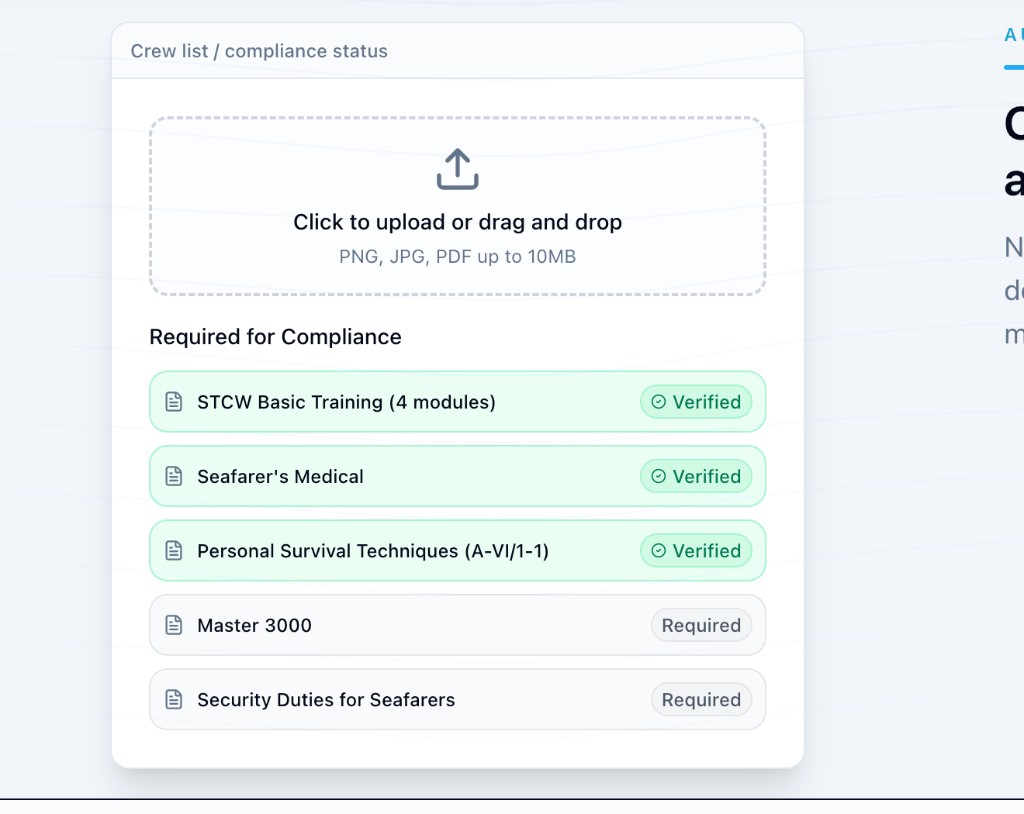
You know the process. A new candidate needs to be verified before they go to a client. You ask for their certificates. A few PDFs land in your inbox — mixed formats, one scanned sideways, another that's a compressed folder with no labels. You cross-reference what they've sent against a role checklist you built yourself. Something might have expired. You email back. They send a clearer version two days later. You check again.
The placement hasn't moved. You've just spent most of a week on document admin.
This is how crew verification still works for most people in this industry. And it has a fundamental problem that's nothing to do with efficiency — it's a problem of what's being measured.
Compliance isn't a status. It's a match.
Ask the wrong question and you get a useless answer. "Is this candidate compliant?" sounds like a yes or no — but it's not, because compliance only means something in relation to a specific role.
A chief officer berth on a 60-metre has completely different certification requirements than a deckhand position on a 30-metre. A stewardess role with childcare duties requires Enhanced DBS clearance and specific first aid qualifications that another stewardess role simply doesn't. The same crew member can be fully compliant for one appointment and ineligible for the next — not because anything has changed about them, but because the role requirements are different.
That's the insight Compliance Links are built on. Instead of checking whether a candidate is "compliant" in the abstract, they check whether a candidate meets the exact requirements of a specific role — and they give you a clear, AI-verified answer.
How Compliance Links work: the four steps
Step 1: You define what the role requires
Before anything is sent to the candidate, you set the criteria for the position — the specific certificates, qualifications, and checks required for that job. Not a generic crew checklist. The actual requirements for this role, on this vessel, for this appointment.
Step 2: The link goes to the candidate
The candidate receives a personalised verification link — no app download, no new account required. They follow the link and are guided through uploading the documents that apply to their role criteria.
Step 3: CrewPass AI verifies the documents
This is the step that changes the workload. Documents aren't reviewed manually. CrewPass AI processes each upload: checking authenticity, extracting certificate details, confirming validity dates, and cross-referencing everything against the role requirements you set.
Step 4: You get a clear answer
Compliant — or not compliant — for that specific role. Not a pile of PDFs to sort through. Not a manual cross-check against a spreadsheet. A clear result, with the evidence behind it, sitting on the candidate's profile.
What this means for recruiters in practice
The recruitment workflow changes significantly when verification isn't built around email and manual checking.
Candidates can be put through verification at any stage in the process — before they're sent to a client, before they're shortlisted, or before a final offer. Because the result is attached to their profile rather than buried in an email thread, it can be shared directly with the client. Because the criteria were set by you, the client can see exactly what standard was checked.
The speed difference is real. A verification that typically involves multiple email exchanges, follow-up chases, and manual checking — across several days — completes in hours. Sometimes less, depending on how quickly the candidate uploads their documents.
More importantly, the result is consistent. Two candidates verified for the same role go through the same criteria, the same AI check, the same standard. The recruiter who happens to be having a stressful day doesn't make a different call than they would on a quieter week.
What this means for management companies
For recruitment, Compliance Links solve a speed and consistency problem. For yacht management companies, they solve a scale problem.
When you're managing multiple vessels with rotating crew, the challenge is maintaining a consistent compliance standard across every appointment — not just verifying candidates one at a time. Different roles on different vessels have different requirements. Manual oversight doesn't hold up at scale.
Compliance Links let you set role-specific criteria once and apply them consistently across every appointment that follows. Every chief officer position on every vessel goes through the same verification flow. Every appointment is checked against the same standard — regardless of how many vessels you're managing or how busy the team is.
The results are stored directly on each crew member's Living Profile, alongside their background check and employment history. When an auditor or insurer asks for documentation on a vessel, you're not pulling records from multiple systems. You're downloading an Export Pack.
What gets verified
The certificates and qualifications checked through Compliance Links depend entirely on what the role requires. Common examples include:
- STCW qualifications — Basic Safety Training, PSCRB, AFF, GMDSS, and advanced certifications
- MCA certifications — OOW, Chief Mate, Master, and engineering officer certifications
- Flag state endorsements — specific to the vessel's flag and applicable regulations
- Medical certificates — ENG1 medical fitness, first aid qualifications, advanced medical care where required
- Enhanced DBS clearance — for roles involving access to children or vulnerable adults
The list isn't fixed. That's the point — you define what the role needs, and that's what gets verified.
The right question to ask
The maritime industry has always done crew verification. Certificates get requested, checked, and filed. The process exists — it just doesn't scale, doesn't produce consistent results, and doesn't leave a useful audit trail.
Compliance Links are built around a better question: not "is this person compliant?" but "does this person meet the requirements of this specific role?" When you start there, everything downstream — the candidate experience, the client conversation, the audit trail — becomes more reliable.
If your current verification process still runs through email, you're not just spending time you don't have. You're getting answers to the wrong question.